We fine-tune language models on your domain's exact workflows and run them inside your infrastructure. Private, no API costs, and more reliable than a general model on the tasks that actually matter to you.
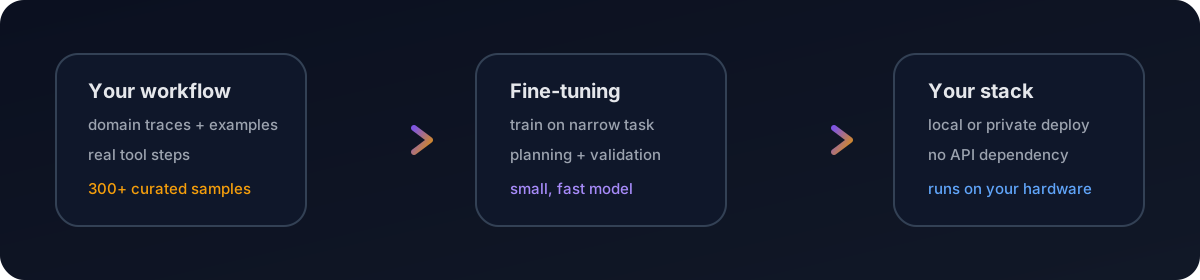
General LLMs are trained to predict the average token across all human knowledge. A focused model is trained to predict the right token in your specific context.
General models are large because they carry ancient Roman history, cooking recipes, and everything else. If your workflow is DevOps, legal review, or customer support — you don't need any of that. A focused model puts its full capacity into the domain you actually care about.
Focused models learn to call one tool at a time, check outputs before proceeding, and handle errors the way a practitioner in that domain would.
Deployed on your servers — a compact model on a developer machine or a 70B running on company hardware. No API costs, no data leaving your network, no latency to a remote endpoint.
Models are trained to show their work — structured planning before acting, with visible reasoning that can be audited or interrupted.
Because it does one thing, it does it quickly. Typical tasks complete in seconds, not the minutes a general model spends considering irrelevant possibilities.
The process is tight and deliberate. We don't fine-tune blindly — every training decision maps to observable behaviour on real tasks.
We work with you to map the exact workflows, tool calls, decision trees, and failure modes the model needs to handle. Scope matters — the narrower, the better.
Real workflow traces, structured tool call sequences, error recovery paths. Data quality over quantity — we'd rather have 300 high-quality examples than 3,000 noisy ones.
We select a base model sized for your constraints — a compact model for edge or developer use, or a larger one (up to 70B) for deployment on company infrastructure. Fine-tuned and delivered in a format ready for your stack.
Before delivery we benchmark the model against real tasks in your domain — not synthetic test sets. You see what it does on actual problems before you deploy it.
Our first focused model targets Docker and Kubernetes workflows — the reference implementation that validates the approach.
The problem with using a general LLM for DevOps automation: it tries to call all tools at once, doesn't validate command output before proceeding, and handles errors by guessing rather than checking. A practitioner doesn't work that way.
We fine-tuned Qwen3-1.7B on 300+ Docker and Kubernetes workflow traces — real sequences of commands, real error states, real recovery paths. The result executes one tool at a time, shows explicit planning with structured reasoning before each action, and validates each step's output before continuing. When something fails, it tries a logical alternative rather than repeating the same mistake.
It runs locally via Ollama on any laptop, completes typical DevOps tasks in around 10 seconds, and requires no GPU. The entire model is under 1 GB.
Tell us the workflow you want to automate and the infrastructure it needs to run on. We'll scope what a focused model looks like and what's realistic.
info@apinference.com